
Lessons from the road #5: what presence makes possible
August 27, 2026
19th anniversary of the UN Declaration on the Rights of Indigenous Peoples
September 19, 2026Our peace and social justice work has been covered in four news items recently:
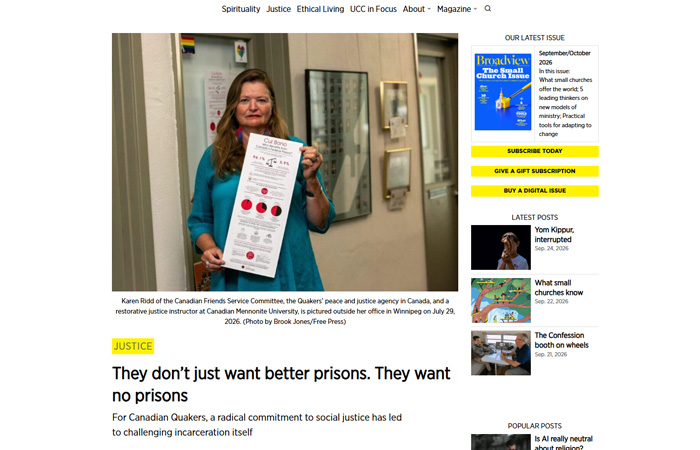 They don’t just want better prisons. They want no prisons: for Canadian Quakers, a radical commitment to social justice has led to challenging incarceration itself
By Josiah Neufeld, Aug. 7, 2026, Broadview
A few weeks ago, the erstwhile punk-rock-poet John Samson Fellows taught an auditorium full of people how to fold a paper cup. With each fold, he explained that origami is an activity he likes to do with people who are incarcerated. “It can be really empowering to make something with your hands in that environment,” he explained over the rustle of fingers creasing paper.
Samson Fellows is perhaps best known as the former frontman for the indie-rock band the Weakerthans and the author of an anthem beloved in his hometown for its self-deprecating refrain: “I hate Winnipeg.” But for the last number of years, he’s been teaching creative writing and literacy to people in Manitoba jails.
“Three weeks ago, while I was still preparing for this talk, I got a furious email from a manager from the Winnipeg Remand Centre where I lead classes,” Samson Fellows told his audience as they put the finishing touches on their paper cups. “He informed me that origami paper is contraband and told me to stop sharing it with my students immediately.”
When Samson Fellows called back to apologize and ask why origami paper was considered contraband, he was told that any object that could be modified into something else was forbidden.
“So,” he said, pausing to give weight to his next words: “Anything that can be changed or transformed is not permitted in the Winnipeg Remand Centre. Any change or transformation is not allowed in Manitoba prisons,” he repeated. “In case I am being too subtle, this is an anecdote about how prisons can’t be reformed, and must be abolished.”
To most of the audience, this was likely not a revolutionary statement — though its implications surely are. Samson Fellows was speaking to a roomful of Quakers, a Christian denomination known for its radical commitment to social justice, convening in Winnipeg for their annual gathering.
 Faith groups concerned by growing military spending
 Faith groups concerned by growing military spending
By John Longhurst, Aug 8, 2026, The Winnipeg Free Press
Sandra Wiens is in charge of government relations for the Canadian Friends Service Committee, also known as Quakers. She believes “there are far better ways to spend money than on the military” when it comes to global security.
Quakers are especially concerned about how military spending might take money away from social programs and foreign aid, she said, and about the lack of funding for peacekeeping. That historic approach to international conflict “has been systematically dismantled over time,” Wiens stated.
Wiens also believes there is a need for a national conversation about what security means to Canadians. For her, that conversation would include questions such as: “What are the threats? What are the best ways to address them? What are we cutting to fund the military? What is the role of foreign aid? What will lessen conflict, or create more of it?”
Right now, there is no space for those questions, Wiens said.
“Let’s start a conversation. Let’s listen to other voices … let’s not only talk about military necessity.”
Read the rest of this article.
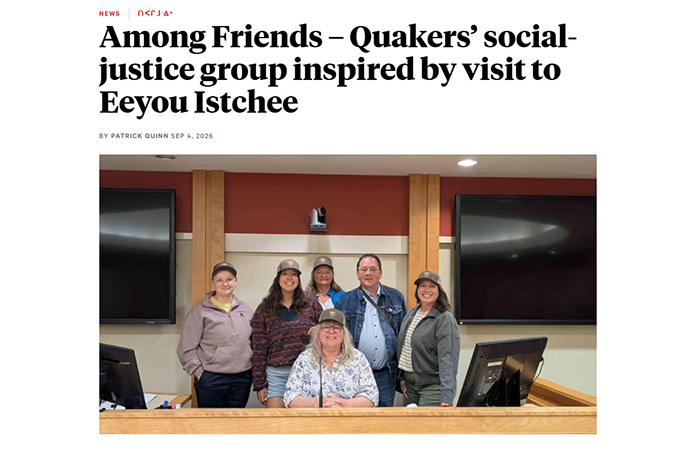
Among Friends – Quakers’ social-justice group inspired by visit to Eeyou Istchee
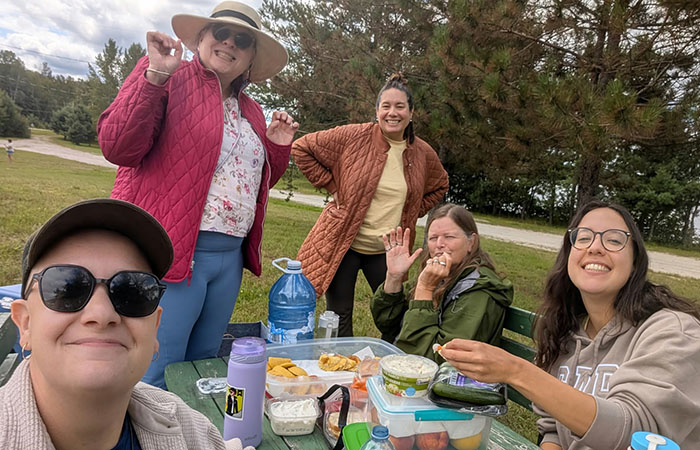
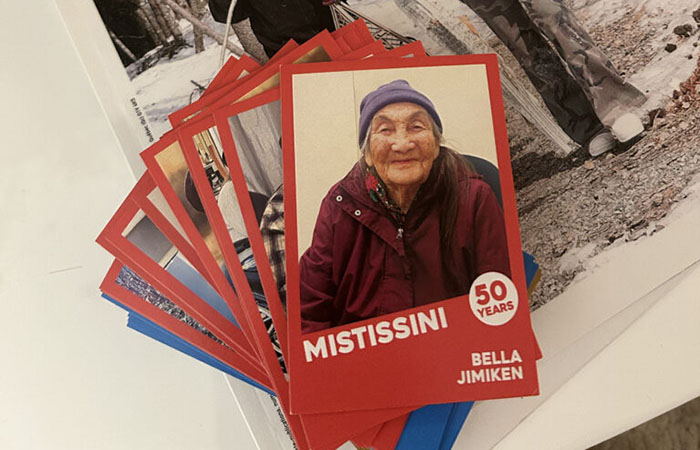
A group of five women from the Canadian Friends Service Committee (CFSC), the social justice arm of the Quakers, returned to Ottawa from a memorable visit to Eeyou Istchee full of gratitude for Cree hospitality and inspiration for their work in advancing Indigenous rights.
The trip was organized by CFSC general secretary Jennifer Preston, who spent part of her childhood in Waskaganish and has long known Donald Nicholls, the Cree Nation Government’s director of justice and correctional services, through their mutual work at the United Nations.
“My team was thrilled to go up to Eeyou Istchee,” said Preston. “Since the 1970s, the Quakers have been doing a lot of work on Indigenous rights and the Crees were always one of our big partners in the international work developing the UN Declaration on the Rights of Indigenous Peoples.”
Read the rest of this article.
The bare minimum: Canadian Quakers advocate for a guaranteed livable basic income
 The bare minimum: Canadian Quakers advocate for a guaranteed livable basic income
By Shanai Tanwar, Sep 14, 2026, THIS
Sandra Wiens stepped into the role of government relations representative for the Canadian Friends Service Committee (CFSC) two years ago. Upon joining the Quaker group focused on peace and justice, she was one of the members who noticed a pattern. It seemed like unhoused people who were previously incarcerated were asking to go back to prison, and some even wanted to remain there.
“We’re prison abolitionists,” says Wiens. “So we don’t really agree with the idea of people being in prison because we find it is a harm[ful] place. It’s like a prison to poverty pipeline. That really underpinned how we started looking into and researching with other networks to see why they were working on the guaranteed livable basic income.”