Annual accountability report 2026
November 3, 2026 Canada has released its first national security policy in more than twenty years. But, according to a new analysis by CFSC, The Plan for a Stronger Canada: National Security for Canadians:
- Misidentifies security as being for the State and the economy rather than for people.
- Commits Canada to an unprecedented military build-up without a public account of its costs or trade-offs.
- Leaves the CAF as Canada’s default emergency responder.
- Is nearly silent on conflict prevention, diplomacy, and peacebuilding.
- Names climate change as a threat but does not resource addressing it.
- Seeks to secure the Arctic through military presence rather than recognizing Inuit Peoples’ sovereignty and rights and working in partnership with Inuit Peoples.
- Expands security and intelligence powers without matching attention to oversight, civil liberties, and conscience.
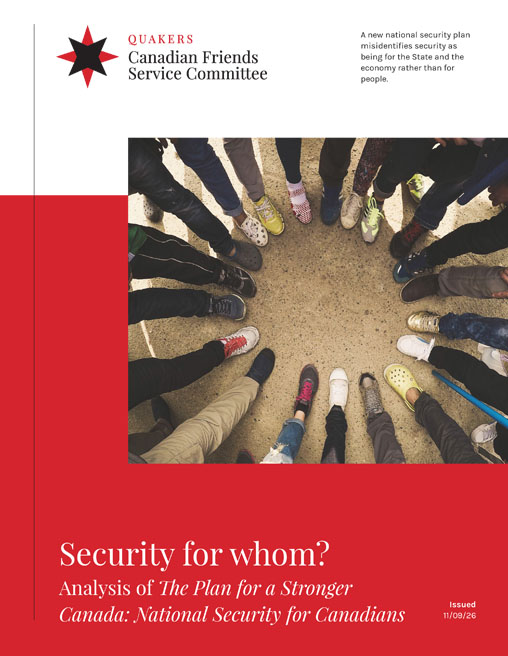
Read our full analysis (PDF).
We call on the Government of Canada to:
- Adopt a human-security definition of national security, adding housing, income security, health system capacity, and climate resilience to Canada’s strategic capabilities.
- Publish a full costing of the path to 5% of GDP, including what it will displace, report annually to Parliament, and use NATO’s 2029 review to reassess the target.
- Direct a defined share of new defence-related spending—beginning with, but not limited to, NATO’s 1.5% resilience category—to conflict prevention, diplomacy, climate monitoring, and civil preparedness.
- Establish a standing civil climate protection force (such as the Youth Climate Corps), coordinated through a national climate-security task force, so the Canadian Armed Forces is no longer Canada’s default emergency responder.
- Restore conflict prevention and peacebuilding as an explicit pillar of national security, with multi-year funding and a peace lens applied across government.
- Reverse cuts to climate science and international development assistance, and decline to subordinate assistance to trade interests.
- Ground Arctic security in Inuit leadership, the UN Declaration on the Rights of Indigenous Peoples, community wellbeing, and diplomacy.
- Drop the target of a 50% increase in arms exports, report transfers to the United States, and
- Strengthen independent oversight and explicit protection for peaceful protest and conscience.
- Include civil society and peacebuilding organizations in implementation, and invite a parliamentary study of conflict prevention.
- Measure security by community wellbeing, through a resilience index built on existing indicators of housing, food security, income, and health access.