
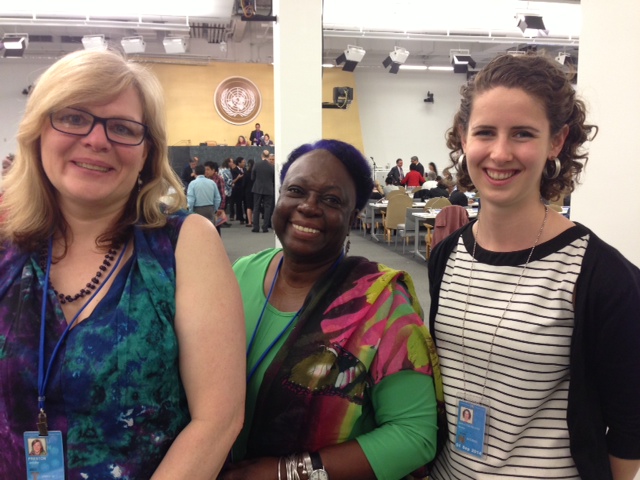
CFSC's Jennifer Preston, Monica Walters-Field and Rachel Singleton-Polster at the UN Permanent Forum on Indigenous Issues 2014
Canadian Friends Service Committee is a small team and much of the work is done by volunteers, so employment opportunities are available only infrequently. We appreciate all interest, but it is our policy only to respond to candidates who are invited to interview for a position. Thank you for your understanding.
Employment opportunities
None at present. All job opportunities will be published through our monthly E-News. You can subscribe below or follow us on social media (@CFSCQuakers) to stay informed.
Volunteer opportunities
Check the service opportunities page to learn about ways you can take positive actions to let your life speak.
Grants
CFSC individual grant—up to $2,000
Who can apply? Canadian Quakers and regular attenders of Canadian Quaker Meetings who are undertaking activity related to a peace or social justice concern, or are working to meet a social need (local, national, or international). Those who have received a CFSC individual grant within the last three years are encouraged to seek other sources of funding so that individual grants may be made available to as many Friends as possible.
In-Canada project grant—up to $1,000
Who can apply? Any group of Canadian Quakers who are undertaking local activities related to a peace and social justice issue and have the support of a local Meeting. Proposals should have a clear relationship to a Quaker testimony, clearly articulate how the project or event will address a local need in the application, and be supported by a minute of record from the associated Monthly Meeting. Eligible expenses include things such as space rentals, speaker fees, food/catering for an event, supplies and materials, and communications. Tuition and training expenses that are for personal learning are not eligible. Applicants will be required to submit a report to CFSC upon the reasonable completion of the project/event that the funding is supporting, and within the year the funding was granted.
Individual peacemaker grant—up to $500
Who can apply? Canadian Friends and regular attenders who are undertaking activities related to peace and social justice, or are working to meet a social need (local, national, or international). Proposals should have a clear relationship to a Quaker testimony, clearly how the project will advance the work of peace in the application, and be supported by a minute of record from the associated Monthly Meeting. Eligible expenses include space rentals, travel, meals, supplies and materials, and communications. Tuition and training expenses that are for personal learning are not eligible. Applicants will be required to submit a report to CFSC upon the reasonable completion of the project that the funding is supporting, and within the year the funding was granted.
CFSC Reconciliation fund grant—up to $1,000 per year
Who can apply? Indigenous people only.
What kinds of projects qualify? The Reconciliation fund supports grassroots, community-based efforts of Indigenous people in Canada who are working on cultural and language revitalization and other projects. A Grant advisory committee advises on CFSC's decisions on grant applications. The Grant advisory committee is made up of Indigenous individuals CFSC has worked together with for many years. Grants are generally up to $1,000 per year with the possibility of applying for continued funding as needed. Find out more and download the application form.
Indigenous rights project grant—up to $1,000
Who can apply? Indigenous people, Indigenous organizations, Friends, regular attenders, or Meetings seeking funding for work supporting Indigenous peoples' human rights.
What kinds of projects qualify? Proposals should be for grassroots projects (initiated by Indigenous peoples or Quakers working with them) that contribute to the self-determination of Indigenous peoples. Quaker connections are useful, but are not required. Usual maximum grant is $1,000.
Policy on Reconciliation fund and Indigenous rights project grants
The history of settlers imposing external constraints and requirements on Indigenous peoples leads us to take special care to guide our relationships with Indigenous peoples by CFSC’s values. We have long worked to avoid colonial practices in relations with Indigenous partners, and to avoid being overly bureaucratic.
Transformative justice project grants—up to $1,000
Individuals or organizations, whether Quaker or not, may apply. The project must work to prevent, repair, and move beyond harm in relation to the justice system. It must work through means that are healing for all concerned and for society as a whole.
Consideration will be given to if there is a Friend/Monthly Meeting close to, or involved in, the project.
Rather than providing sustained core funding to established organizations, preference will be given to:
- Projects that others will not fund.
- Seed money for new projects/initiatives.
- One-off kinds of projects.
Notes about CFSC grants
All work must be carried out in ways consistent with CFSC’s values and that serve CFSC’s overall mission. This includes in particular that those involved in the work should be able to participate regardless of personal characteristics such as race, religion, ethnic affiliation, gender, age, sexual orientation, marital status, etc. Commitment to equality of persons entails actively working to welcome people with diverse experiences and identities in the CFSC funded project.
For all grants, prospective applicants are asked to contact us, to see if their leading may be eligible and to receive an application form.
We do not provide funds for projects that are completed or are near completion. Salaries, tuition, and training expenses usually are not eligible.
All grant applications are reviewed as they are received. This process can take several months to generate a decision.
Recipients of CFSC grants will be required to submit a financial report with original receipts showing how the funds were used. Additionally, applicants will send CFSC a description or story of how CFSC’s funds were used in service of the leading in question. This should include pictures when appropriate. More information about reporting and timelines will be provided to successful applicants.
Educational bursaries
CFSC believes that education is both a personal and societal act of transformation. It shapes the values and capacities our communities express in response to the pressing challenges of our time.
Many people are deeply committed to the same principles that guide CFSC’s work. Yet financial barriers to education limit who can participate in building the just future we seek. By supporting students pursuing education in fields that align with our areas of work, we invest in the long-term flourishing of a more peaceful and equitable world. Our educational bursaries recognize the potential for students to be change-makers.
In addition, when students engage in rigorous study and research within our areas of concern, their findings expand the evidence-base that informs our advocacy.
Eligibility
All student applicants need to be dedicated to understanding, promoting, and supporting peace in all its forms—personal, interpersonal, and structural—and preventing and transforming violence.
Eligible academic programs
All applicants must be currently located in Canada and eligible to receive financial aid. Bursaries are available to students who have been accepted and have confirmed their spot in a program that’s headquartered in Canada at a recognized post-secondary institution (college, university, or equivalent) in a program that aligns with the principles of nonviolence, peacebuilding, or conflict transformation. Applicants must be willing to share resulting relevant academic research/papers with CFSC’s program staff. Examples of eligible fields:
- Peace and conflict studies.
- International development or global affairs (with a peace/conflict focus).
- Political science (with concentration in diplomacy, mediation, or human rights).
- Law (specializing in humanitarian law or alternative dispute resolution).
- Social work or community development (emphasizing nonviolent intervention or trauma-informed practice).
- Environmental studies (when addressing climate justice as a factor in peace and conflict).
To be eligible, at least part of the program should demonstrate:
- A commitment to nonviolent conflict transformation.
- An interdisciplinary approach that links inner, interpersonal, and structural peace.
- Critical reflection on power, inequality, and justice.
- A focus on restorative and relational practices over punitive ones.
- Practical applications such as mediation, dialogue facilitation, or peace education.
- Ethical or spiritual reflection on peace as both an inner discipline and a social practice.
Eligible non-academic or experiential programs
Recognizing that peace work extends beyond classrooms, bursaries may also support participation in training, certification, or field experiences that embody Quaker principles of peacebuilding. Examples include:
- Unarmed civilian accompaniment programs (e.g. Peace Brigades, Community Peacemaker Teams)
- Peace education certificates offered by nongovernmental organizations or peace institutes
- Nonviolence training (e.g. Kingian or Gandhian nonviolence courses)
- Human rights observation or advocacy training
- Conflict transformation workshops (local or international)
- Internships with organizations focused on peace or disarmament
Selection considerations
All applicants should be able to demonstrate:
- A clear connection between their studies or training and the advancement of peace and justice, consistent with Canadian Friends Service Committee’s definitions.
- Evidence of community engagement, activism, or volunteer work related to peace or transformative justice.
- Intent to apply their learning in the service of nonviolent social change, advocacy, system transformation, or community strengthening.
- (Preferred) alignment with or awareness of Quaker values and history of peace work.
- Financial need (details will be provided to qualified applicants)
- Current residency/visa in Canada, including a valid Social Insurance Number (details about this will be provided to qualified applicants).
To see if you qualify please contact us. Deadline to apply is May 30th of each year, for award the following school year.