

Joint submission to the International Covenant on Civil and Political Rights review of Canada
March 2, 2026 Chances are you’re not a bloodthirsty maniac. Most people aren’t. Research suggests that even torturers and mass murderers don’t usually do what they do just for the fun of it. Instead, overwhelmingly, people who cause tremendous harm to others tell themselves stories that rationalize and justify their actions. One powerful story that helps us support killing other people is that “there is no alternative” (made famous with the acronym TINA).
One study asked a group of participants if they supported a war.
A second group was asked the same question, but was also told there were no good alternatives.
A third group was asked the question of whether or not they supported the war, and was told that all alternatives had not yet been exhausted.
Unsurprisingly, this third group was far less likely to support the war. What may surprise you is that the responses of the first two groups were the same—they both supported the war about equally.
Think about that for a moment. The finding suggests that unless people are told explicitly that alternatives to war exist, they simply assume that such alternatives do not exist, or that they’ve already been tried and failed.
Both of these assumptions are false.
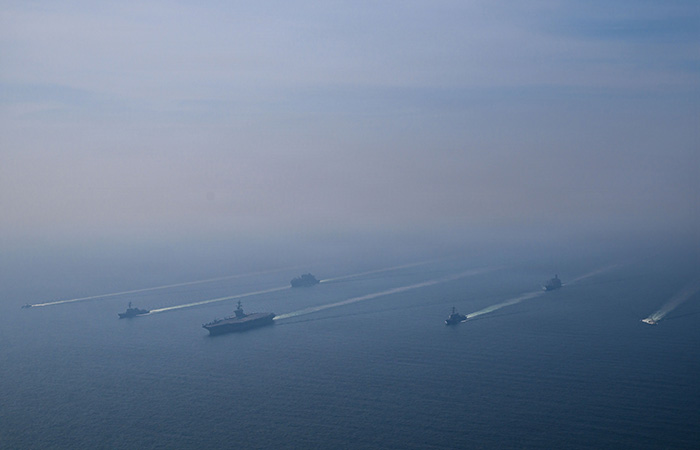
US Carrier Strike Group sails in formation in the Arabian Sea, Feb 6, 2026
Source: Jesse Monford/Wikimedia Commons
There are always alternatives (many in fact)
In researching my book I came across a surprising array of alternatives to wars. Some of these you may have thought about—alternatives like relentless peace diplomacy and smart sanctions on the flow of weapons. Some are more creative—like unarmed groups of civilians training themselves and coordinating to nonviolently prevent invading powers from being able to control their country (often called “unarmed civilian defense”).
Shockingly little investment goes into most of the available alternatives to wars. This costs us. Even if we’re lucky enough to not be directly killed, injured, or traumatized in a war, we don’t escape the impacts. Global military spending is ballooning, having reached $334 per person alive today ($3.7 trillion a year and growing).
The World Bank estimates the economic cost of violent conflicts to be much greater—$1,988 a year for each of us.
Their report found that, even in the most pessimistic scenario, putting more effort and money into war prevention would actually save hundreds of millions just for countries not directly involved in wars.
Investing in sectors other than the military is also good for job creation. Putting that money into education would create more than twice as many jobs.
These numbers don’t take into account war’s contributions to polluting our environment or changing the climate. As just one example, a 2013 US government climate action plan notes that the US Department of Defense is “one of the world’s worst polluters” creating thousands of contaminated sites and being “the single largest consumer of energy in the United States.”
With so many great reasons to spend more on programs that increase safety and wellbeing, why do so many of us assume that “there are no alternatives” to more and more wars?
Lack of clarity
One challenge may be a lack of clarity about whose job prevention is. Imagine if your country wanted to go to war but no government body had the responsibility to make the call, and planning its military strategy was divided across dozens of different departments. The military would be inefficient and couldn’t do much.
Many countries have highly coordinated and well-trained militaries, yet very few have anything close to a similarly respected and funded government body tasked with taking strategic and coordinated actions to prevent war. An international campaign by some civil society groups calls for governments to establish Ministries of Peace or similar government structures—an intriguing idea for improving the capacity and will to engage seriously with building peace.
Misleading popular messaging
Another reason that we’re not more aware of alternatives to war is that we’re exposed to so many pro-military messages and stories. This happens both in mainstream media coverage and in entertainment. Movies and shows are especially powerful because emotional content is a great way to influence beliefs while people’s critical thinking guards are largely down.
Matthew Alford and Tom Secker spent years filing hundreds of freedom of information requests to uncover something very surprising. Popular Hollywood movies and shows about wars and national security aren’t just written by creative people—they’re altered, sometimes heavily, by the US government. And although this had been known for some time, the scale Alford and Secker uncovered was dramatic: this was happening about ten times more than previously known.
Over 800 popular movies and thousands of TV episodes, about half of all works on topics like wars or capturing violent extremists—each with the power to shape mainstream culture and ideas about morality, history, and security—had been financially supported and influenced by government agencies with a vested interest.
The result is what so many of us are familiar with and imagine is “normal” or “inevitable.” It’s the so often repeated good versus evil story, where the violent force of the good guys is all that stands in the way of evil triumphing. These Hollywood fables present an overly simple vision of why militarism is the only option for solving a range of problems.
What has been kept out of these influential depictions of war? Alford and Secker say the single biggest thing might be depictions of soldier suicides (in many recent wars US soldiers have been much more likely to commit suicide than to die in combat).
They told journalists that other items edited from the popular media include: “War crimes, illegal arms sales, CIA involvement in drug trafficking, black operations (coup d’états and assassinations and so on), sex crimes committed by military personnel, sexism and racism in the military, drug and alcohol abuse in the military… portraits of anti-war figures, military incompetence, and any depiction of the military being bested or beaten by an opponent, regardless of whether that opponent is a Colombian drug cartel or a giant lizard.”
A version of this post originally appeared on Psychology Today. Learn more about peace.