
Why is the UN Declaration on the Rights of Indigenous Peoples necessary?
 In its own words, the UN Declaration on the Rights of Indigenous Peoples sets out minimum standards necessary for the “dignity, survival and well-being” of Indigenous Peoples.
Indigenous Peoples globally continue to face discrimination, dispossession of their lands and resources, forced assimilation, and other grave human rights abuses.
The UN Declaration on the Rights of Indigenous Peoples is the most comprehensive international human rights instrument to address the economic, social, cultural, political, civil, spiritual, and environmental rights of Indigenous Peoples.
The Declaration affirms the inherent, or pre-existing, collective human rights of Indigenous Peoples, as well as the human rights of Indigenous individuals. It provides a framework for justice and reconciliation, applying existing human rights standards to the specific historical, cultural, and social circumstances of Indigenous Peoples.
Canada’s Truth and Reconciliation Commission called the UN Declaration “the framework for reconciliation” between Indigenous and non-Indigenous Peoples in Canada.
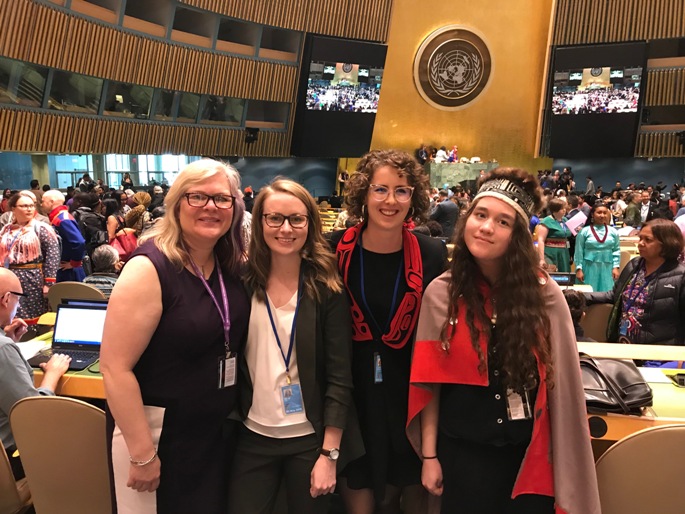
Our 2019 delegation to the UN Permanent Forum on the Rights of Indigenous Peoples: Jennifer Preston, Keira Mann, Rachel Singleton-Polster, and Haana Edenshaw.
When was the UN Declaration adopted?
The UN General Assembly overwhelmingly adopted the Declaration on September 13, 2007. This historic adoption followed more than 20 years of deliberation and debate in which Indigenous Peoples worked directly with governments to elaborate on and advance their human rights!
Quakers and the UN Declaration
Quakers worked in solidarity with Indigenous partners for more than two decades toward the adoption of the UN Declaration on the Rights of Indigenous Peoples.
As the national peace and social justice agency of Quakers in Canada, Canadian Friends Service Committee participated in UN Working Groups where the Declaration was negotiated. We also did years of intense lobbying together with partners. This resulted in the adoption of the Declaration by the UN.
Since then (2007), CFSC has continuously supported efforts to see the Declaration implemented. With our partners we work on legal, political, and social implementation. This work has included producing a book, giving presentations to politicians and government employees, and innumerable public talks and private discussions.
All of these decades of efforts have been to educate, inform, and move forward full respect for Indigenous Peoples’ inherent human rights as affirmed in the Declaration. See this panel including CFSC’s Jennifer Preston for an example of the presentations we give:
Canada has adopted the UN Declaration on the Rights of Indigenous Peoples into law
After many years of effort by so many, including CFSC, Bill C-15, An Act Respecting the UN Declaration on the Rights of Indigenous Peoples became law on June 21st, 2021. (The Act was built from a previous private members bill by Romeo Saganash, which CFSC was also closely involved with.)
We are now working together with partners to ensure that governments live up to their promises under the Act.
Read about the journey to achieving Declaration legislation in Canada and the impact that this legislation can have.
Coalition for the Human Rights of Indigenous Peoples
An important way we engage in our work on the UN Declaration is through the Coalition for the Human Right of Indigenous Peoples. It’s an informal non-partisan group of Indigenous Peoples’ and human rights organizations that seeks the full implementation of the Declaration. See these recent joint statements from the Coalition for a sense of the issues it works on and the positions it advocates.
Learn more about the UN Declaration
Bill C-15 and the implementation of Indigenous Peoples’ human rights in Canada resource from the Global Indigenous Rights Research Network. (2021)
Implementing the UN Declaration on the Rights of Indigenous Peoples: myths and misrepresentations. (2020)
Interpreting the UN Declaration on the Rights of Indigenous Peoples. (2018)
Educational resource developed by KAIROS with support of multiple member churches seeking to implement the UN Declaration on the Rights of Indigenous Peoples. (2017)
Read the Declaration
Pocket-sized copies
Pocket-sized copies of the UN Declaration on the Rights of Indigenous Peoples are available in both English and French. Contact us to place an order (50 cents per booklet plus shipping).
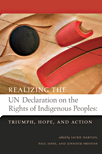
Book
Edited by Jackie Hartley, Paul Joffe, and Jennifer Preston, Realizing the UN Declaration on the Rights of Indigenous Peoples: Triumph, Hope, and Action (2010) documents the story of the Declaration from idea to adoption by the UN. It details the many challenges that Indigenous Peoples and human rights supporters had to overcome along the way. This is a detailed but accessible introduction to the Declaration. While some things have changed since the book came out in 2010, it remains highly relevant today.
Why are Quakers involved in this work?
Some Quakers have been concerned about colonialism for centuries, and a conflict in 1974 between the Ojibway people and the police and colonial powers near Kenora, Ontario, cemented Canadian Friends Service Committee’s commitment to ongoing work for justice for Indigenous Peoples.
These events prompted Friends to be present and to hear firsthand the longstanding grievances concerning land rights, housing, medical care, education, Indigenous spirituality, and child welfare in Kenora, and elsewhere.
Since that time, CFSC has used the Quaker tradition of ‘quiet diplomacy’ to become a fixture in domestic and international work to recognize, promote, and protect the human rights of Indigenous Peoples.
Our approach
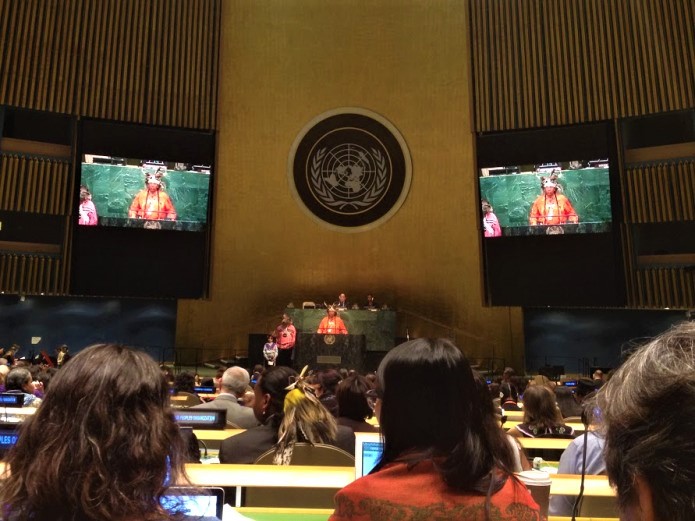
Through careful consideration and consultation with Indigenous partners, CFSC focuses our work on two areas: implementing the UN Declaration and promoting and learning from the work of the Truth and Reconciliation Commission of Canada.
Canadian Friends Service Committee:
- Works with Indigenous partners to educate ourselves and the wider Canadian society on the concerns of Indigenous Peoples, stimulating active participation in supporting those concerns.
- Provides small grants from our Reconciliation Fund to grassroots Indigenous groups working for self-empowerment.
- Supports Indigenous Peoples in their efforts to have their human rights recognized. This includes:
- land rights and self-determination.
- spirituality: acknowledging the right of Peoples to worship in the way of their own cultures and faith traditions.
- Indigenous rights as affirmed in the UN Declaration and as protected under the Canadian Constitution.
- Engaging in dialogue with governments, corporations, and international organizations such as the United Nations.
- Cooperating with coalitions engaged in the work of securing Indigenous Peoples’ individual and collective human rights.
How this work advances: international Indigenous rights forums
UN Expert Mechanism on the Rights of Indigenous Peoples (EMRIP)
Established in 2007, the Expert Mechanism exists to provide the UN’s Human Rights Council with expertise on the rights of Indigenous Peoples. EMRIP consists of seven independent experts. CFSC attends these meetings as one of the key international forums where we can support the advancement of Indigenous Peoples’ human rights. EMRIP has a standing agenda item on the implementation of the UN Declaration.
UN Permanent Forum on Indigenous Issues
The Permanent Forum is an advisory body with the mandate to:
- Provide expert advice and recommendations on Indigenous issues to programs, funds, and agencies of the United Nations.
- Raise awareness and promote the integration and coordination of activities related to Indigenous issues within the UN system.
- Prepare and disseminate information on Indigenous issues.
CFSC has attended the Forum since its inception in 2002 and works with partners to raise issues of concern, particularly the implementation of the UN Declaration and human rights of Indigenous Peoples in Canada.
UN Special Rapporteur on the Rights of Indigenous Peoples
In 2001, the UN created the position of UN Special Rapporteur on the Rights of Indigenous Peoples to:
“Examine ways and means of overcoming existing obstacles to the full and effective protection of the human rights and fundamental freedoms of Indigenous people…”
The Special Rapporteur also works in close cooperation with the UN Permanent Forum on Indigenous Issues. CFSC follows the work of the Special Rapporteur and, as appropriate, engages with them.
Universal Periodic Review
The Universal Periodic Review (UPR) was created in 2006 as a cooperative process that reviews the human rights records of all UN Member States once every four years. The UPR provides the opportunity for each State to declare what actions they’ve taken to fulfill their human rights obligations. CFSC works with partners to make joint submissions to the UPR on Canada’s performance on Indigenous Peoples’ human rights.
Historic work
Tsilhqot’in Nation’s title case
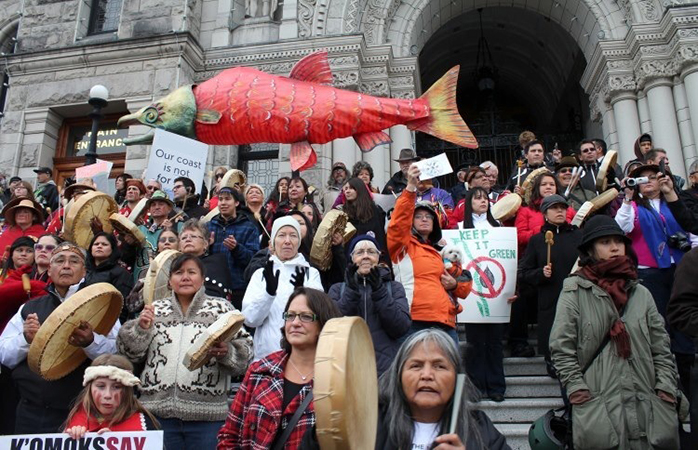
People show support for Tsilhqot’in Nation on the steps of the BC Legislature. Photo credit: Union of British Columbia Indian Chiefs.
“What is at stake is nothing less than justice for the Aboriginal group and its descendants, and the reconciliation between the group and broader society.”
—Court’s statement
In it’s unanimous decision in 2014, the Supreme Court of Canada recognized the right of the Tsilhqot’in people to own, control, and enjoy the benefits of approximately 2,000 square kilometres of land at the heart of their traditional territory in central British Columbia.
Amnesty International and Canadian Friends Service Committee made formal interventions in the Tsilhqot’in title case to encourage the Supreme Court to adopt an approach to Indigenous land rights that would be consistent with international human rights standards, including the UN Declaration.
In its decision, the Court advised, “Governments and individuals proposing to use or exploit land, whether before or after a declaration of Aboriginal title, can avoid a charge of infringement or failure to adequately consult by obtaining the consent of the interested Aboriginal group.”
Read Tsilhqot’in Nation v. British Columbia in plain language. This document explains: Why did the Tsilhqot’in have to go to court? What did the lower courts say before the case reached the Supreme Court? What did the Supreme Court decide? What are some of the problems with the Supreme Court’s decision? Why is the decision important for the Tsilhqot’in People and all Indigenous Peoples?
Grassy Narrows
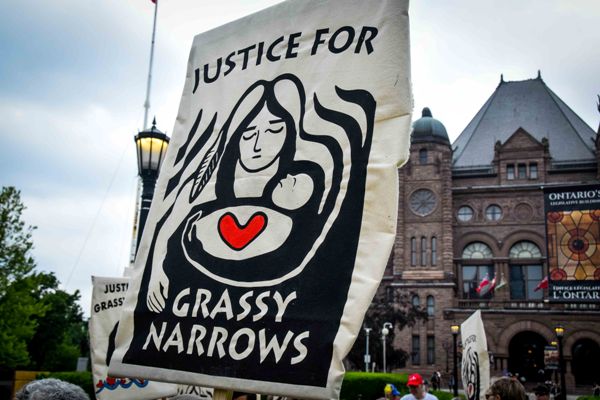
Grassy Narrows River Run at Provincial Legislature building in Toronto, 2019.
Concerns about mercury poisoning affecting the Ojibway communities of Grassy Narrows and White Dog in Ontario in 1974 galvanized Canadian Friends. Grassy Narrows continues to seek justice for mercury poisoning as well as unauthorized development on their traditional territory.
For years CFSC has joined many groups in urging the government of Ontario, forestry companies, and other corporations to respect international human rights standards that require the free, prior, and informed consent of Indigenous Peoples for decisions that affect their land and resource rights.
Impacts of industrial projects on women and children
CFSC is deeply concerned by the impacts of resource development projects on many aspects of Indigenous Peoples’ human rights. We recommend reading this study, looking at what happens in remote Indigenous communities when industrial camps are set up. Findings include increased rates of sexual assault, addictions, sexually transmitted infections, and family violence. The study was initiated by Lake Babine First Nation with the Nak’azdli Whut’en First Nation.
Doctrine of discovery
The doctrine of discovery comes from a series of formal charters by the Pope, originating in the 1400s. These were used as legal and moral justification for colonial powers to dispossess sovereign Indigenous nations. Christians claimed lands that they “discovered” for their monarchs, who could exploit those lands, regardless of the original inhabitants.
The doctrine is racist. It is based on the notion of the racial superiority of European and Christian peoples and individuals. This false belief has been used to dehumanize Indigenous Peoples, and to exploit, subjugate, and dispossess them of their most basic rights. This ideology has led to practices that continue through modern day laws and policies in Canada.
The doctrine of discovery has been used in interpretations of law by Canadian courts in modern times. In 2012 the BC Court of Appeal referenced the doctrine of discovery while interpreting their decision in Tsilhqot’in. As mentioned above, the decision was later unanimously overturned by the Supreme Court of Canada.
The Supreme Court stated, “The doctrine of terra nullius (that no one owned the land prior to European assertion of sovereignty) never applied in Canada, as confirmed by the Royal Proclamation (1763).”
The Truth and Reconciliation Commission has called on all faith bodies to repudiate the concepts used to justify European sovereignty over Indigenous lands and Peoples. Many faith groups are examining discovery and repudiating it. The World Council of Churches has done so. In 2023 the Vatican also formally repudiated the doctrine of discovery.
When Canadian Quakers met at our national gathering (Canadian Yearly Meeting in session) in 2013, we were in deep and immediate unity that the doctrine of discovery must be repudiated by Quakers as a religious community, as well as by the government of Canada.
Read the full statement prepared by Canadian Friends Service Committee and further background materials on the doctrine of discovery.
For simple and easy-to-share information download Frequently Asked Questions about the Doctrine of Discovery (PDF).
In 2013 we also argued to the Supreme Court of Canada that discovery must be repudiated in law.
CFSC produced the following video of a panel discussion we participated in at the closing events of the Truth and Reconciliation Commission of Canada.