
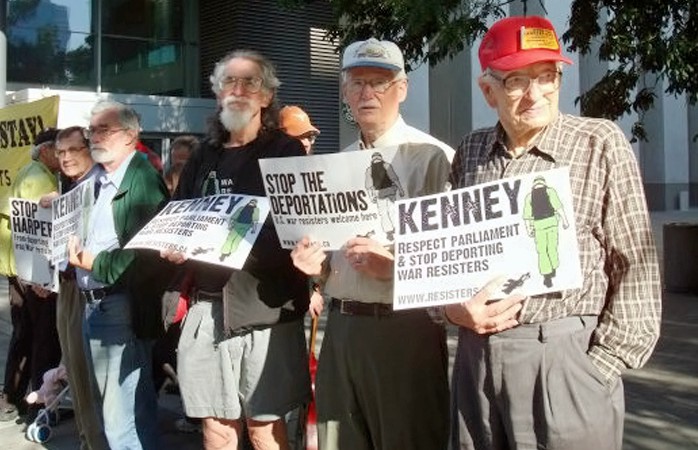
Protesting for justice—a longstanding Quaker tradition. Pictured: Rally in support of a US war resister in front of the Federal Court, 2010.
Canadian Friends Service Committee has a rich history starting way back almost a century! Below is a brief overview but if you're excited about Quaker history you can connect with the Canadian Quaker Library and Archives, which welcomes requests for information on the history of CFSC.
In 1931 members of three Quaker yearly meetings were led to create Canadian Friends Service Committee so they could have a shared place to engage in peace and social justice work.
For centuries, Quakers have been exploring the tough question of how to respond effectively to violence. Historian Robert Byrd explains, “Friends’ primary interest has been in the underlying causes and forces at work in international affairs, or, in [early Quaker George] Fox’s phrase, in ‘taking away the occasions for war.’” All of CFSC’s work, whatever the focus, can be understood as continuing that way of looking at issues.
In 1947 Quaker service agencies were awarded the Nobel Peace Prize for non-partisan medical support offered to all sides in war (this later became a common approach used by groups like the Red Cross/Red Crescent). In his awards speech, Norwegian leader Gunnar Jahn said, “The Quakers have shown us that it is possible to translate into action what lies deep in the hearts of many: compassion for others and the desire to help them...”
Canadian Friends’ participation in wartime and post-war relief and witness generated deep commitment to the work CFSC came to stand for. During World War II, many conscientious objectors served through doing Quaker relief, reconstruction, and ambulance work. When they returned to Canada, many joined CFSC.
Interested in hearing more stories about the history our peace and social justice work? Check out our Get to Know Thee, Friend series to hear in-depth presentations directly from various Friends who have made CFSC's work possible over the years.
Peace work
From 1963 to 1976, CFSC operated a Friends Peace Education Centre on Grindstone Island, south of Ottawa, providing creative peace and reconciliation programs for people seeking to imagine, dialogue about, and practice more peaceful ways of engaging in interpersonal and international disputes. Programs included training in nonviolence, French-English dialogue, conferences for diplomats, and Quaker-UNESCO seminars organized by the Canadian Peace Research Institute.
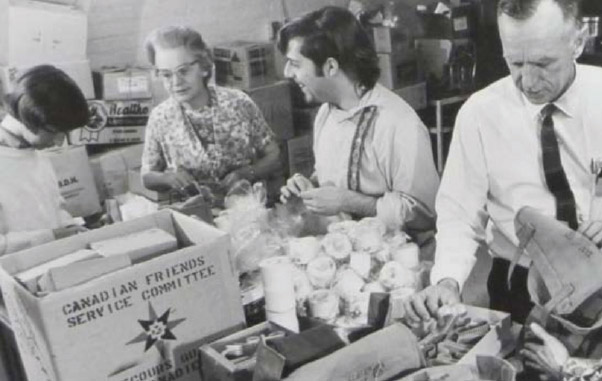
CFSC volunteers preparing medical aid packages to send to Vietnam
During the Vietnam War many war and draft resisters came to Canada from the United States. Some participated in Grindstone Island programs; some were assisted by Quaker Meetings, individual Friends, and families; and some settled in Canada and became Friends.
During the Vietnam War, CFSC responded to requests from Vietnamese hospitals by sending medical supplies to be used by victims on all sides of the war in accordance with Friends’ tradition of non-partisan medical aid. Many American Friends knowingly contravened U.S. law by contributing to this work through Canadian Friends.
For some, the program was controversial, but for many it was a labour of love in war-time. It provided considerable aid to the sufferers and served as a witness against war.
In 2004, CFSC began welcoming a new wave of US war resisters, those fleeing the Iraq War. CFSC worked towards their ability to stay in Canada.
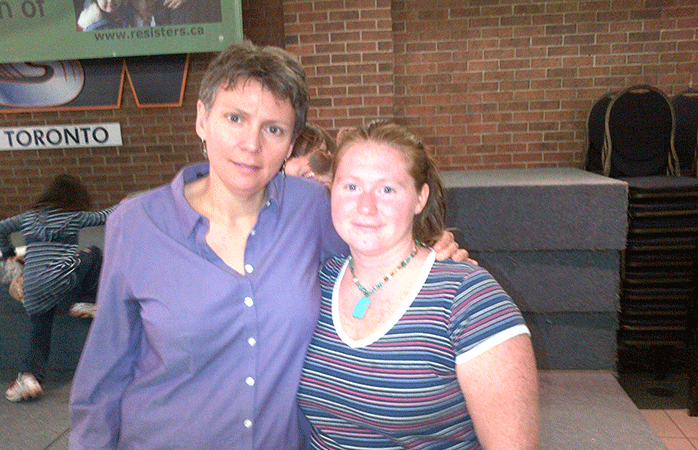
Former CFSC staff Jane Orion Smith and conscientious objector to the Iraq war Kim Rivera, Toronto, 2012
Our recent work has included support for locally-led grassroots peacebuilding efforts in many parts of the world, such as helping to train volunteer conflict mediation teams in Kinshasa, DR Congo, and funding trauma healing, gender-based violence reduction, and community building work in the Africa Great Lakes region. We have supported conscientious objection not only to military service, but also to military taxation.
Over the decades we've continued to develop and refine our understanding of peacebuilding and how Canada can contribute constructively to making our world more peaceful. We've supported peace policies, opposed Canada’s involvement in war and the arms trade, and called for a federal department with a focus on researching and developing effective peacebuilding strategies. We’ve worked in peace networks and coalitions and taken action on issues from nuclear war to the “war on terror.” Our focus is always on Canada’s involvement and policies.
Friends have reflected deeply on wars and how people may be protected without killing, leading to our 2014 booklet The Four Elements of Peacebuilding: How to Protect Nonviolently (PDF). This led to further research to discernment to define and test our ideas about peace. This led to our focus since 2016 on peace education. We wrote the award-winning 2019 book Are We Done Fighting? Building Understanding in a World of Hate and Division and have offered many talks and workshops using practical tips, stories, and other content from the book.
Development work
In the 1950s and 1960s, two Canadian Quaker families served at the Friends Rural Centre, Rasulia, India, supported by CFSC and Friends Service Council (now Quaker Peace and Social Witness) in London, UK.
By the 1970s the development work that Canadian Friends had done in Rasulia changed to financial support for a larger number of projects in collaboration with other development agencies, later including the Canadian International Development Agency (now within Global Affairs Canada).
Today CFSC maintains some select support for small but creative locally-led international projects that promote human rights and peace.
Indigenous Peoples’ human rights
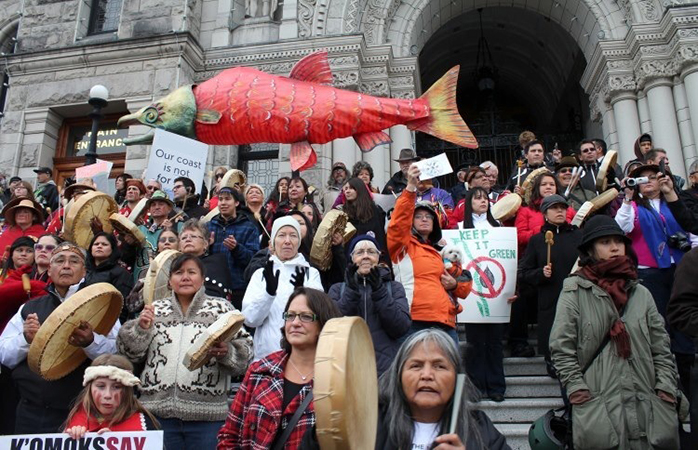
Photo credit UBCIC
Some people may have read romantic stories about how William Penn (1644-1718) landed in Lenni Lenape territory and founded Pennsylvania. More realistic views about Quakers' complicated history with Indigenous Peoples will continue to evolve as further historical research is done.
From the first days, some Friends were egalitarian in their approaches and were welcomed by, and had respectful relationships with, Indigenous Peoples. Friends like Lucretia Mott (1793-1880) appear to have valued Indigenous governance and learned from and been inspired by Indigenous Peoples on areas such as gender equality. At the same time, Friends were among those involved in dispossessing Indigenous Peoples’ lands. Some promoted assimilation and sought to coerce and compel Indigenous Peoples to adopt European ways and Christian beliefs.
In the United States, Friends ran what were called “Indian Boarding Schools.” Like residential schools in Canada, the US schools facilitated the seizing of Indigenous children from their families and communities with the express purpose of destroying Indigenous cultures, languages, and spiritualities. Widespread physical, sexual, and spiritual abuse also took place at residential schools. Some Friends in the US are currently working to address this traumatic legacy.
In Canada, residential school survivors won the largest class action suit in the country’s history, a settlement to which some Churches were legal parties. The Religious Society of Friends wasn’t one of them, having not been involved in residential schools here. Although not directly involved, like other settlers, Friends were part of the colonial culture of Canada and paid taxes, so in those ways they were as responsible as other citizens of Canada for the residential school system. Additionally, it appears likely that Genesee Yearly Meeting was supportive of the US schools in the 1860s. (Genesee was one of the three Yearly Meetings that merged into Canadian Yearly Meeting in 1955.)
Since the 1960s, CFSC has advocated for Indigenous Peoples' human rights, for example through nonviolent activism at the request of the Innu Nation and the Lubicon Lake Nation. Friends also supported community building initiatives, and urged governments to live up to their legal commitments to Indigenous Peoples.
In 1974, individual Friends went to Grassy Narrows in Northern Ontario to attempt to learn about the situation and support the protection of Indigenous rights in a confrontation over mercury contamination. A Quaker physician treated community members suffering from mercury poisoning and documented the problem.
In the 1990s and 2000s, CFSC worked with many Indigenous partners and human rights organizations to encourage governments to develop the UN Declaration on the Rights of Indigenous Peoples. This work involved a great deal of coordination with partners and travel to engage with UN delegates from different countries.
The UN finally adopted the Declaration in 2007 after decades of deliberation. Several organizations that had worked together toward the adoption of the Declaration are now part of the Coalition for the Human Rights of Indigenous Peoples, which seeks the full implementation of the UN Declaration in Canada. This focus has seen CFSC participating in UN meetings in New York and Geneva and doing a great deal of educational work about the Declaration, both for the general public and for key decision makers.
We've been involved in particular court cases to advance the Declaration, such as intervening at the Supreme Court of Canada in the landmark Tsilhqot’in Nation title case. We have also actively been involved with supporting Quakers to take action toward reconciliation. One of the concrete ways we support reconciliation efforts is through giving grants from the Reconciliation Fund.
In short, over the centuries Friends have both participated directly in, and opposed, the project of colonization. Friends continue to benefit from and be harmed by colonialism. In response, many Friends seek to reconcile for the future, and have been involved in the work of reconciliation for decades. Acknowledging this mixed and at times deeply troubling history is important. The subtitle of the TRC’s final report is Honouring the truth, reconciling for the future.
Transformative justice
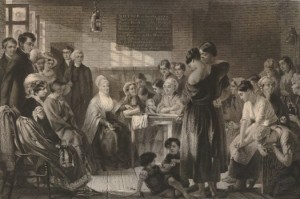
Quaker Elizabeth Fry reading to the prisoners in Newgate, 1816. CC-BY British Museum
In the 1600s members of the Religious Society of Friends (Quakers) experienced being imprisoned for their beliefs. The worldwide community of Quakers has worked on concerns related to criminal justice ever since. This has included founding organizations such as the Elizabeth Fry Society and the Alternatives to Violence Project, promoting restorative justice processes, and participating in the establishment of norms and standards at the United Nations. It has also included some well-intentioned but disastrous decisions, such as being instrumental in the creation of solitary confinement. Some Friends thought, wrongly, that silence and solitude would help people to reform and live better lives.
In Canada, CFSC began work on transformative justice issues following a 1972 call from British Friends to support abolishing the death penalty in the United Kingdom. From this call, Canadian Friends worked to campaign for the end of capital punishment in Canada until its abolishment in 1976. Canadian Friends then began to broaden their work to the wider prison system and eventually toward developing alternatives to prison. In 1978, Canadian Friends Service Committee took up this work with Friend Ruth Morris becoming a leading force on it in Canada and internationally.
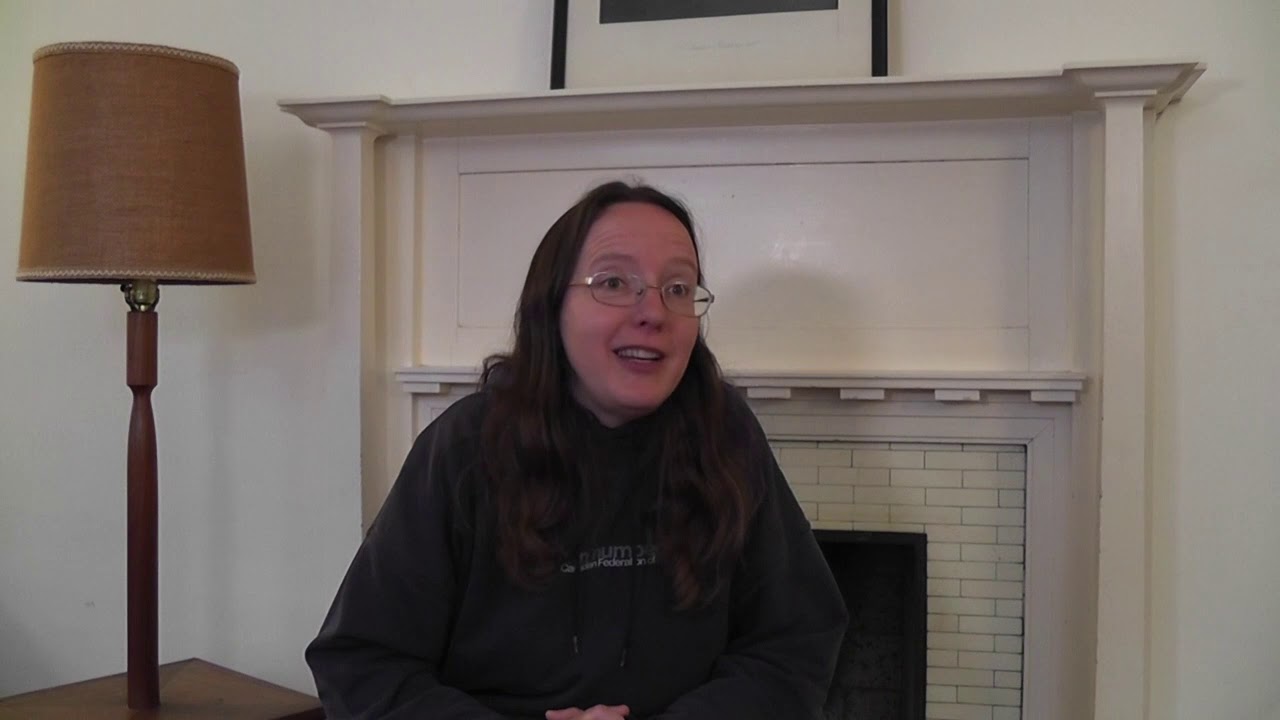
As far as we can tell in 1981 the Religious Society of Friends became the first religious body anywhere in the world to endorse an end to prisons (PDF) while recognizing ”a need for restraint of those few who are exhibiting dangerous behaviour” but calling for this restraint to be humane. The work of CFSC and Ruth Morris also led to the establishment in 1982 of the International Conference on Prison Abolition, now called the International Conference on Penal Abolition. In this brief video Ruth’s daughter Joy, a former CFSC member, tells us about what it was like growing up in a household that often welcomed people who were in trouble with the law:
CFSC worked to encourage prison visiting, provide programs and supplies to prisoners, seek alternatives to prisons, raise awareness of the roots of crime and violence in society, and provide small grants to other organizations in support of prisoners and their families. In the 1990s, as one alternative to prisons, CFSC supported the establishment of the Alternatives to Violence Project in Canada (an experiential conflict transformation and healing program originally developed by Quakers working with inmates in the US and now used internationally). CFSC continues Friends’ commitment to penal abolition and fostering just and compassionate ways of life.
For more details see this two page history of CFSC’s work in transformative justice.
Quaker International Affairs Program
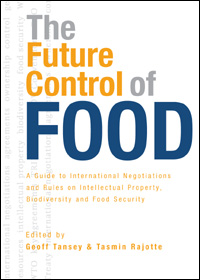
CFSC’s book The Future Control of Food
In 2001 CFSC established a Quaker International Affairs Program in Ottawa, building on earlier work in facilitating dialogue in international affairs, such as the diplomats’ conferences held on Grindstone Island in the 1960s. The work of the Quaker International Affairs Program happened in collaboration with the Quaker United Nations Offices based in Geneva and New York. It brought together diplomats, government officials, and international non-governmental organizations. The program was closed a decade later, but many of its publications on intellectual property rights, food security, and traditional knowledge remain in use, trusted for their expertise and balance. This work and expertise helped when Canadian Friends, through CFSC, later studied and worked on ethical and spiritual issues related to synthetic biology for some years.
Further reading
A more detailed background on CFSC can be found in a 2011 issue of the magazine The Canadian Friend, which celebrated our 80th anniversary.
You can also read this brief summary of CFSC's history (PDF), written in 2007.